Showing posts with label Info for Parents. Show all posts

Friday, 25 March 2016

A guest lecture – Connecting students with nature

Last week, on March 17thTeachers Training for Sustainability, held its first workshop of the semester; we welcomed Dr. Chris Buddle and, a Master's student at McGill University, Chris Cloutier who led us in a discussion on their latest research as it relates to sustainability education. In particular, Buddle highlighted his work on spiders living in the arctic while Cloutier provided examples of public engagement through late-night nature walks. Overall, the workshop was a great success, with feedback from attendees being highly positive regarding “the two Chrises’” interesting content and humorous style!


Written by: Harley Nadler


Friday, 18 March 2016

Are Electric Cars really green?

Author: Harley Nadler


One may question the efficacy of driving an electric car, for the purpose of reducing a carbon footprint, when accounting for the emissions of the car’s production as well as the emissions from the electricity used to power it. Indeed, until auto-makers begin to use less plastic in the car’s body and accessories, the production of the car itself leaves a lasting mark on the earth. Nevertheless, the production of electric cars is no worse for our environment than that of their non-electric predecessors. All things being equal, what really determines how green a car may be is what powers it.

To advertise a car as zero emissions may be fundamentally misleading; even if the emissions from production are ignored. A savvy consumer will ask where their electricity comes from before lamenting on how sustainable their vehicle may be. Unfortunately, this has more to do with geography than anything else. As outlined by ShrinkThatFootprint.com, countries in which large proportions of electricity are generated by burning coal, or other fossil fuels, may consider their electric cars to create effectively the same amount of emissions as a gas-powered car. In other words, the same amount of carbon is burned; in one case the carbon is burned by the car while in the other case the carbon is burned at the coal plant.

In an ideal world, one could simply subscribe to a choice of electric companies offering whatever means of power-generation their customers prefer. However, the infrastructure for such a system simply does not exist at this time. As such, we are faced with two possibilities:

1)    Resign ourselves to the fact that we happen to live in a city where sustainable energy is not readily available and simply drive a traditional gas-car, or
2)    Reject the notion that we are a coal community and, instead, demand sustainable forms of power such as solar, wind, geothermal, etc.

Obviously, one of those options is more difficult and takes longer to invoke. However, with municipal governments across the globe taking the lead on sustainable action, the task is not as daunting as lobbying a federal government.

The very first step is educating yourself!! How does your power company generate electricity? If it happens to be a healthy mix of wind and nuclear, you can make a significant change to your carbon footprint by upgrading to an electric vehicle (you may even have some incentives from your government or power company available to you). However, if your power company is using mostly coal or natural gas, your greatest impact may be a letter to your mayor or city councilor. When issues of energy are decided at a state or provincial level, your city officials are a strong ally in a lobby for sustainable energy on the grid.


Harley Nadler is a 3rd year undergraduate student in the Faculty of Education at McGill University. He holds a Diplôme d'études collégiales (DEC) in Pure & Applied Sciences and is currently studying with the goal of teaching science at the high school level. Harley is a big believer in sustainability education as a means of affecting public policy.

Friday, 15 November 2013

The American Academy of Pediatricians issues tougher guidelines for kids’ media use

You read that right. Pediatricians have recently come out with new guidelines for parents regarding the recommended amount of time and access to media, published in the journal Pediatrics. The article linked excessive media use to health problems such as obesity and recommends that children should be limited to less than two hours of entertainment-based screen time per day.

Currently, the average 8 year old spends 8 hours using media, teenagers surpassing 11 hours of of media consumption.

We're hoping that less time in front of a screen means more time outdoors, experiencing the real world!

To read the full article (on some recent big wins for the Children & Nature Movement) click HERE.


Thursday, 14 November 2013

Ontario Creates "Children’s Outdoor Bill of Rights"


Give a guess at how many hours children (in school today) spend outdoors playing, doing physical activity, etc?

Three. Including weekends.

The same children spent approximately 7 hours in front of screens.

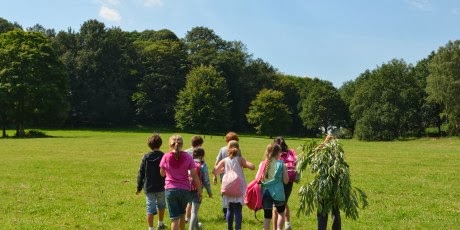
Actually, sadly enough, children are spending more time indoors than at any other time in human history. Our children's connection to nature has been impaired and resulted in a "nature-deficit" and its a fact. Thankfully there is something we can do about it, and many people have already taken this problem into their own hands. These people are enthusiastic teachers and parents who take their kids outdoors to explore and learn from the nature all around us.

Wednesday, 18 September 2013

Indoor Education for Outdoor Learning? What'a Wrong with This Picture?


A great blog post put together by the Children and Nature Network asks and addresses questions such as:
Why do teachers in training not have at least some preparation in using the out-of-doors and nature as a place for their students to learn?

Evidence from research is clearly stating that children need nature and outdoor experiences on a daily basis for their physical, emotional and mental wellbeing. What is going on? Why almost all education indoors?

Read this article for more information this question and the research done on the irony of how teachers are doing outdoor education indoors.

Monday, 2 September 2013

The No Impact Project: Tips and Lesson Plans for Students, Parents and Teachers


The No Impact Project, which is accompanied with a book, film and blog, is a non-profit project aimed to educate our society about the environment and promote behavioural change.


In addition to proving itself a useful resource for students and parents that would like tips on how to pursue a more sustainable lifestyle, it also includes five 50-minute lesson plans for students from Grade 6-12. These educational tools, which can be used individually or together, provide engaging and thoughtful activities on the topics of: consumption, energy, food, transportation and water. Read more for a description of each of these lesson plans.

Friday, 30 August 2013

Quebec Ranked 9th in Canada in Science Education


More primary-school science urgedAn interesting article published in the Gazette on August 22, 2013 has brought the spotlight on the science education in primary schools, with the Gazette noting that in primary education in Quebec, science is the first subject to be cut when teachers run out of time. Quebec ranked 9th out of Canadian provinces in territories for student performance in science.
Read more for details on this evaluation and future steps.

Saturday, 10 August 2013

Simple things you can do to save electricity at home and at school

Here's a great website resource put together by students, for students called Earth Buddies! On this website is a long list of awesome energy saving tips that are quick and easy. This is a great site because it's tried and true for home and school. They are suggestions for student activities by students themselves... so we know they must be fun and they must work!

To find the activities, head to the website HERE and click on "At School" (on the left hand side of the page). Scroll down and look for the section on "How to Improve the Environment at Your School".

You can learn how to work with your students to:

  • Hold Earth Celebrations at school
  • Recycle at school
  • Save trees at school
  • Save electricity at school
  • Save water at school
Enjoy browsing through this resource!

Kid's Corner - teaching your students about energy consumption!


Canada's SaveOnEnergy Program is a program for homes and businesses to help make it easier to manage their electricity use.

5 Tips for Teaching Kids About Sustainable Living

"How Stuff Works" is a great online resource for teaching students how things work, from the ordinary to the extraordinary, in simple terms. "How Stuff Works" also has 5 tips that we think are great for teaching your students or your children about Sustainable Living:

Tip #1: Volunteer in a green activity with your kids or students:
This is a great way to lead by example in teaching your students or kids the importance of taking care and being proud of the community they live in (and at the same time teaching them the importance of volunteering and helping others!) Just ask your local community organizations about events such as neighbourhood cleanups etc. If you find that the activity doesn't exist, why not start it yourself?